Indian businesses often use the words “invoice” and “bill” as if they mean the same thing. Under GST they do not. A tax invoice and a bill of supply are two different documents, issued in different situations, and using the wrong one can cost your customer their input tax credit or leave you out of step with the law. This guide explains the difference in plain language, with a quick table and examples.
The short answer
A GST tax invoice is issued when you supply taxable goods or services and charge GST. A bill of supply is issued when you do not charge GST — either because you are a composition-scheme dealer, or because what you are supplying is exempt from GST. Both are required by Section 31 of the CGST Act, 2017: the tax invoice is covered in detail by Rule 46 of the CGST Rules, and the bill of supply by Rule 49.
| GST tax invoice | Bill of supply | |
|---|---|---|
| Charges GST? | Yes — tax is shown separately | No — no tax is charged or shown |
| Issued by | Regular GST-registered suppliers of taxable goods or services | Composition-scheme dealers; suppliers of exempt goods or services |
| Buyer can claim ITC? | Yes, if the buyer is eligible and the details are correct | No — there is no GST to claim |
| Tax columns | Rate, CGST + SGST or IGST, cess where applicable | None |
| Place of supply | Shown for inter-state supplies | Not required |
| Governing rule | Rule 46, CGST Rules | Rule 49, CGST Rules |
| Document title | Tax Invoice | Bill of Supply |
What is a GST tax invoice?
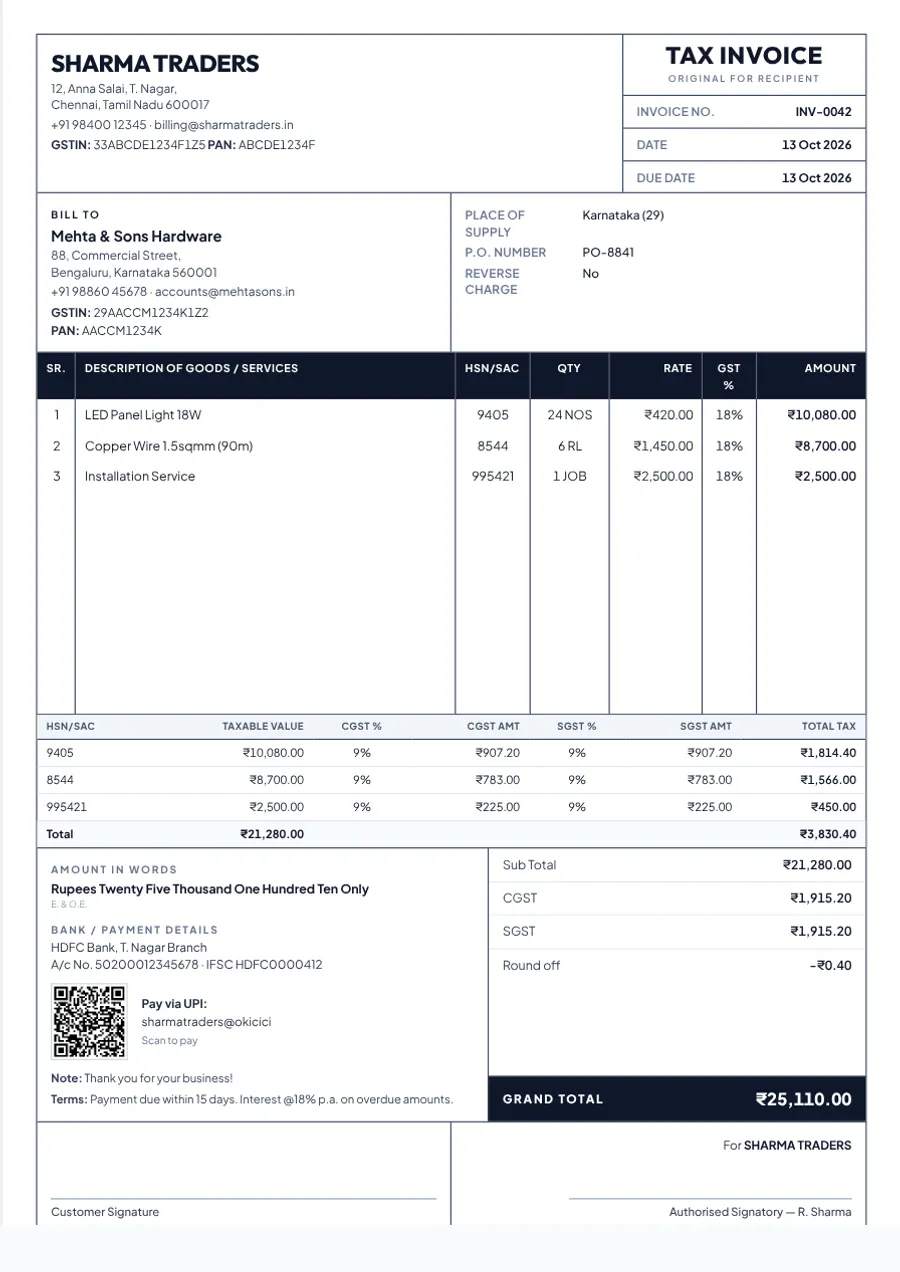
A tax invoice is the document a registered supplier issues for a taxable supply. It shows the value of the supply, the GST rate and the GST charged — split into CGST and SGST for in-state sales or IGST for inter-state sales. Because the tax is itemised, the buyer can use the invoice to claim input tax credit (ITC). The full list of mandatory details is in our guide on how to create a GST invoice.
What is a bill of supply?
A bill of supply is a simpler document. It records what was supplied and its value, but it carries no tax, because none is being collected. Section 31(3)(c) of the CGST Act requires a registered person who supplies exempt goods or services, or who pays tax under the composition scheme, to issue one instead of a tax invoice.
Who issues which document?
- Regular GST-registered supplier of taxable goods or services: tax invoice.
- Composition-scheme dealer: bill of supply, always. A composition dealer cannot collect GST from customers, so it cannot issue a tax invoice.
- Registered supplier of exempt or nil-rated goods or services: bill of supply for those supplies. Examples include certain healthcare and educational services and fresh produce that is exempt under the GST notifications. Whether something is exempt depends on the notification for that item, so verify the entry for what you sell.
- Supplier of both taxable and exempt items: a tax invoice for the taxable supplies and a bill of supply for the exempt ones — or a single invoice-cum-bill of supply in the case described below.
- Business that is not registered under GST: neither document. It cannot charge GST, so it issues an ordinary bill or cash memo.
What a bill of supply must contain
Rule 49 lists the particulars. In summary, a bill of supply must show:
- Supplier's name, address and GSTIN
- A consecutive serial number of up to 16 characters, unique for the financial year (letters, numbers, hyphen and slash only)
- Date of issue
- Recipient's name, address and GSTIN or UIN, if the recipient is registered
- HSN code for goods or SAC for services, where applicable
- Description of the goods or services
- Value of supply, after any discount or abatement
- Signature or digital signature of the supplier or authorised representative
The rules also allow relief for very small sales. For supplies below ₹200 to an unregistered buyer who does not ask for a bill, a bill of supply need not be issued for each sale, provided a consolidated bill of supply is issued at the end of the day. Check Rule 49 for the exact conditions.
What is an invoice-cum-bill of supply?
Imagine a grocery shop that sells exempt items and taxable items to a walk-in customer in one purchase. Rule 46A allows a registered person who supplies taxable and exempt goods or services to an unregistered buyer to issue one combined document, an “invoice-cum-bill of supply”, instead of two separate bills. Where the buyer is a registered business that needs to claim ITC, keep the taxable and exempt supplies clearly separate.
Which one should you issue? Common situations
| Your situation | Document to issue |
|---|---|
| Regular registered dealer selling taxable goods or services | Tax invoice |
| Composition-scheme dealer | Bill of supply (with the composition wording) |
| Registered supplier whose supply is wholly exempt | Bill of supply |
| Registered supplier selling taxable and exempt items to an unregistered buyer | Invoice-cum-bill of supply, or two separate documents |
| Business with no GST registration | Plain bill or cash memo — no GST shown |
What it means for the buyer's input tax credit
Input tax credit lets a registered buyer subtract the GST paid on purchases from the GST owed on sales. That only works if the purchase was supported by a tax invoice that shows the GST. A bill of supply carries no GST, so there is nothing to claim. If you are a buyer and a registered supplier has given you a bill of supply for a taxable purchase, ask why. If you are a seller, remember that issuing the wrong document can hurt your customer.
5 common mistakes to avoid
- Charging GST on a bill of supply, or showing a tax column on it. A composition dealer in particular must not collect tax.
- Issuing a tax invoice from a composition registration. The two cannot go together.
- Leaving out the composition wording on a composition dealer's bill of supply.
- Skipping the customer's GSTIN when the customer is registered.
- Duplicate or non-sequential numbers. Each document series must be consecutive.
Making these documents with BillsFreind
If you are a regular GST-registered seller, the free GST tax invoice generator produces a Rule 46 style invoice with HSN/SAC codes, a CGST/SGST or IGST split, place of supply and amount in words. If you are not registered, the general bill / cash memo is the right format. BillsFreind does not yet have a dedicated bill-of-supply format, so composition and exempt suppliers should make sure whatever they issue is titled “Bill of Supply” and carries the particulars listed above. Wondering how the tax on an invoice is worked out? See how to calculate GST on an invoice.
Related guides: how to create a GST invoice, how to calculate GST on an invoice, HSN code vs SAC code, invoice vs bill vs receipt, proforma invoice vs tax invoice.
Registered and charging GST? Fill in the form, check the live preview and download a print-ready A4 tax invoice — free, with no sign-up and no watermark. Create a GST invoice
Frequently asked questions
What is the difference between a GST invoice and a bill of supply?
A GST tax invoice charges GST and shows the tax separately, so the buyer can claim input tax credit. A bill of supply is issued when no GST is charged — by composition-scheme dealers and for exempt supplies — and shows no tax.
Can a composition dealer issue a tax invoice?
No. A composition dealer cannot collect GST from customers, so it issues a bill of supply instead.
Can the buyer claim input tax credit on a bill of supply?
No. A bill of supply carries no GST, so there is no tax credit to claim. Only a valid tax invoice showing the GST supports an ITC claim.
Is a bill of supply mandatory?
Yes, for a registered person who supplies exempt goods or services or who is under the composition scheme, subject to the small-value relief in the rules. A business that is not GST-registered does not issue one.
Does a bill of supply need a GSTIN?
It must show the supplier's GSTIN. The recipient's GSTIN or UIN is required if the recipient is registered.
Related guides
- Proforma Invoice vs Tax Invoice: What's the Difference?
- Delivery Challan vs Invoice: What's the Difference?
- HSN Code vs SAC Code: What's the Difference?
- Invoice vs Bill vs Receipt: What's the Difference?
By BillsFreind Team · 2026-10-23 · 6 min read