Calculating GST on an invoice is simple arithmetic once you know three things: the taxable value, the GST rate and whether the sale is within one state or between states. This guide walks through the formulas and worked examples for the situations you meet most often — adding GST to a price, removing GST from a GST-inclusive price, giving a discount, and billing items with different rates on one invoice.
The basic GST formula
- GST amount = taxable value × GST rate ÷ 100
- Invoice total = taxable value + GST amount
For example, GST at 18% on ₹1,000 is ₹1,000 × 18 ÷ 100 = ₹180, so the invoice total is ₹1,180. The same ₹1,000 at other common rates:
| GST rate | GST amount | Invoice total |
|---|---|---|
| 5% | ₹50 | ₹1,050 |
| 18% | ₹180 | ₹1,180 |
| 40% | ₹400 | ₹1,400 |
What counts as the taxable value?
GST is charged on the value of the supply — the price the buyer pays for the goods or services, before GST. Under Section 15 of the CGST Act, incidental charges the supplier bills along with the supply, such as packing or commission, are generally part of the taxable value. A discount given at the time of supply and shown on the invoice reduces it. If you are unsure how a particular charge is treated, ask your chartered accountant.
Example 1: Adding GST to a price
You sell goods for ₹8,500 before tax, and the GST rate is 18%.
- GST = 8,500 × 18 ÷ 100 = ₹1,530
- Invoice total = 8,500 + 1,530 = ₹10,030
Example 2: Removing GST from a GST-inclusive price
Sometimes you only know the final, GST-inclusive price and need to work out how much of it is tax. Reverse the formula:
- Taxable value = inclusive price × 100 ÷ (100 + GST rate)
- GST amount = inclusive price − taxable value
| Inclusive price | GST rate | Taxable value | GST amount |
|---|---|---|---|
| ₹11,800 | 18% | ₹10,000 | ₹1,800 |
| ₹2,360 | 18% | ₹2,000 | ₹360 |
| ₹1,050 | 5% | ₹1,000 | ₹50 |
Take the first row: 11,800 × 100 ÷ 118 = 10,000, so the GST is 11,800 − 10,000 = 1,800. Note that you cannot simply take 18% of ₹11,800 — that would give ₹2,124, which is wrong because the 18% applies to the price before tax.
Example 3: GST when you give a discount
When the discount is given at the time of supply and shown on the invoice, GST is calculated on the discounted value. You sell goods worth ₹20,000 with a 10% discount, at 18% GST, within one state:
| Step | Calculation | Amount |
|---|---|---|
| Price before discount | ₹20,000 | |
| Discount @ 10% | 20,000 × 10% | − ₹2,000 |
| Taxable value | 20,000 − 2,000 | ₹18,000 |
| CGST @ 9% | 18,000 × 9% | ₹1,620 |
| SGST @ 9% | 18,000 × 9% | ₹1,620 |
| Invoice total | 18,000 + 3,240 | ₹21,240 |
CGST, SGST and IGST: how the tax is split
The total GST is the same either way — only the split changes. For a sale within one state, the GST is divided equally into CGST (Centre) and SGST (State), each at half the rate. For a sale between two states, the whole amount is charged as IGST. On a taxable value of ₹10,000 at 18%, that is ₹900 CGST + ₹900 SGST within a state, or ₹1,800 IGST between states. Our guide on how to create a GST invoice explains how to decide which applies.
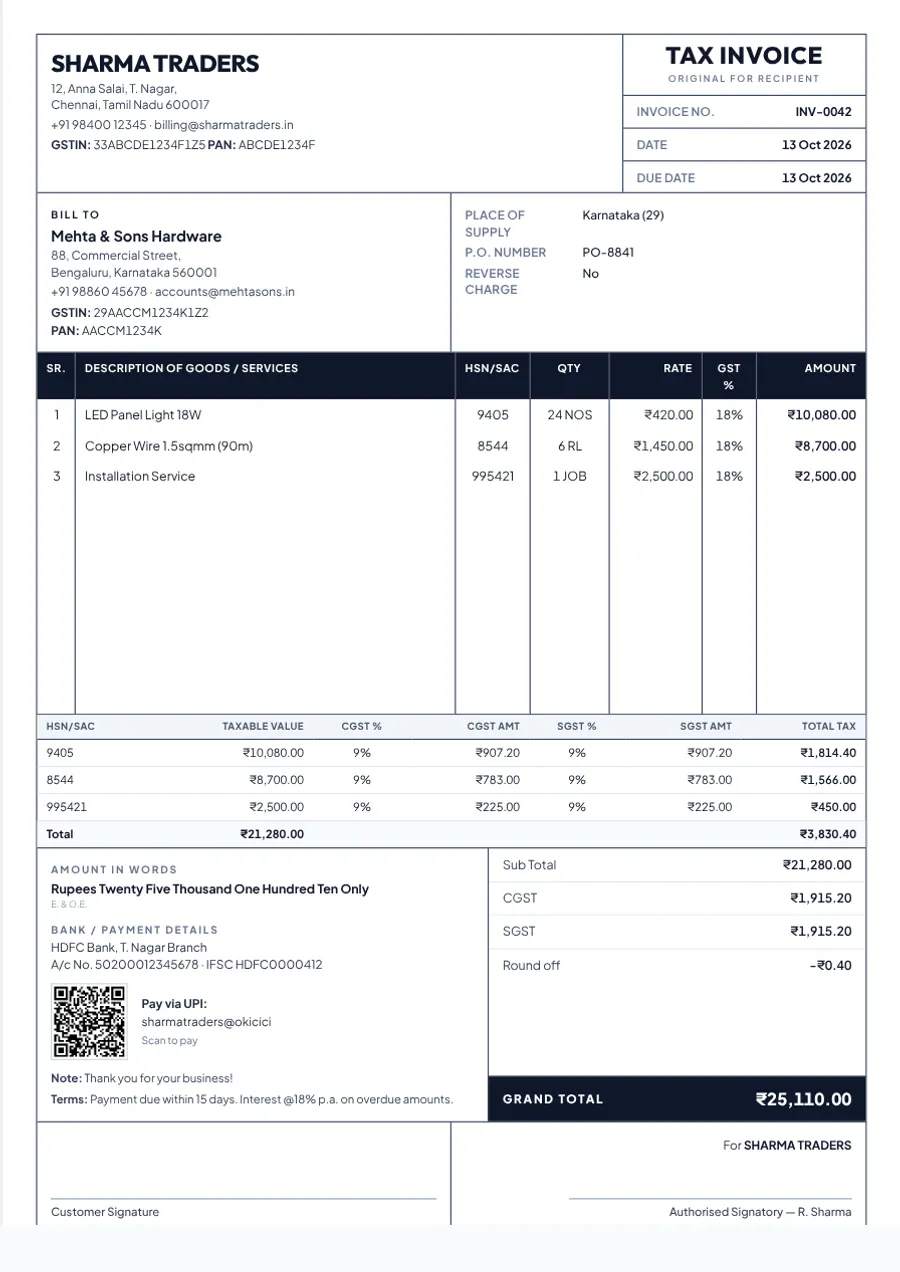
Example 4: An invoice with different GST rates
Calculate GST on each line at its own rate, then add up. Here is a within-state invoice with three items:
| Item | Qty × rate | Taxable value | GST rate | GST |
|---|---|---|---|---|
| Item A | 10 × ₹500 | ₹5,000 | 5% | ₹250 |
| Item B | 4 × ₹1,200 | ₹4,800 | 18% | ₹864 |
| Item C | 2 × ₹750 | ₹1,500 | 18% | ₹270 |
| Total | ₹11,300 | ₹1,384 |
- CGST = 1,384 ÷ 2 = ₹692, SGST = ₹692
- Invoice total = 11,300 + 1,384 = ₹12,684
Which GST rate applies?
The rate depends on the HSN/SAC code of what you sell. Since the GST rate rationalisation on 22 September 2025, most goods and services are taxed at 5% or 18%, with 40% on a small list of select items, alongside 0% for exempt and nil-rated items and special rates such as 3% on gold. Always confirm the rate for your specific HSN/SAC code on the official GST portal or with your chartered accountant, because rates can be revised.
Rounding off the invoice total
Calculations often end in paise. Say three items at ₹999 each are taxed at 18%: taxable value ₹2,997, GST ₹539.46, total ₹3,536.46. Many businesses show a round-off line so the amount payable is a whole rupee — here, −₹0.46, making ₹3,536. The round-off is only a presentation of the total; the tax amounts themselves should be shown accurately.
Let the GST invoice generator do the maths
- Open the generator. Go to the free GST tax invoice generator — no sign-up needed.
- Choose the supply type. Pick Within state (CGST + SGST) or Inter-state (IGST). The tax is split for you.
- Add items with their own GST rate. Enter the description, HSN/SAC code, quantity, rate and GST rate on every line. Enter the rate before GST — the generator adds the tax on top, so if you only know a GST-inclusive price, convert it with the formula above first.
- Add a discount if needed. Enter a discount percentage. GST is calculated on each line after the discount.
- Download the PDF. Totals, tax split, round-off and amount in words update live. Press Download PDF and choose “Save as PDF”.
5 common GST calculation mistakes
- Taking GST on a GST-inclusive price instead of extracting it with the reverse formula.
- Charging GST before subtracting a discount that was given on the invoice.
- Applying one rate to every line when the items attract different rates.
- Charging CGST + SGST on an inter-state sale, or IGST on a local one.
- Using an outdated rate. Check the current rate for your HSN/SAC code.
Related guides: how to create a GST invoice, HSN code vs SAC code, GST invoice vs bill of supply, choosing a free invoice generator in India, electrician, plumber and mechanic bill format.
Skip the manual maths. Add your items, pick the GST rate and download an invoice with the tax already calculated — free, with no sign-up and no watermark. Create a GST invoice
Frequently asked questions
What is the formula to calculate GST on an invoice?
GST amount = taxable value × GST rate ÷ 100, and invoice total = taxable value + GST amount. For example, 18% GST on ₹1,000 is ₹180, so the total is ₹1,180.
How do I calculate GST from a GST-inclusive price?
Divide the inclusive price by (100 + GST rate) and multiply by 100 to get the taxable value; the rest is GST. For ₹11,800 at 18%, taxable value is ₹10,000 and GST is ₹1,800.
How are CGST and SGST calculated?
For a sale within one state, total GST is split equally. At an 18% rate, CGST is 9% and SGST is 9% of the taxable value. For an inter-state sale, the full 18% is charged as IGST.
Is GST calculated before or after a discount?
When the discount is given at the time of supply and shown on the invoice, GST is calculated on the value after the discount.
Can I calculate GST on an invoice for free?
Yes. BillsFreind's GST invoice generator calculates the tax, the CGST/SGST or IGST split and the total automatically — free, with no sign-up and no watermark.
Related guides
- How to Create a GST Invoice in India: Step-by-Step Guide
- Proforma Invoice vs Tax Invoice: What's the Difference?
- HSN Code vs SAC Code: What's the Difference?
- Delivery Challan vs Invoice: What's the Difference?
By BillsFreind Team · 2026-10-23 · 5 min read